
Braided rope is one of the most useful tools you can own—whether you’re boating, camping, climbing, DIY crafting, or handling outdoor work. Thanks to its flexible structure and high durability, braided rope is widely trusted for jobs that require strength, reliability, and smooth handling.
In this guide, you’ll learn what braided rope is, the main types, the best uses, how strong it is, and how to choose the right braided rope for your needs—without wasting money on the wrong material.
What Is Braided Rope?
Braided rope is a rope made by weaving multiple strands together in an interlaced pattern. Unlike twisted rope (which is made by twisting strands around each other), braided rope has a smoother surface and better flexibility.
Braided rope is popular because it offers:
- Strong load capacity
- Smooth handling and easy knotting
- Less twisting and kinking
- Better durability in many conditions
- More professional performance for outdoor and industrial tasks
There are many types of braided rope, and each material is designed for specific environments—water, sun, heavy weight, or everyday use.
Braided Rope vs Twisted Rope: What’s the Difference?
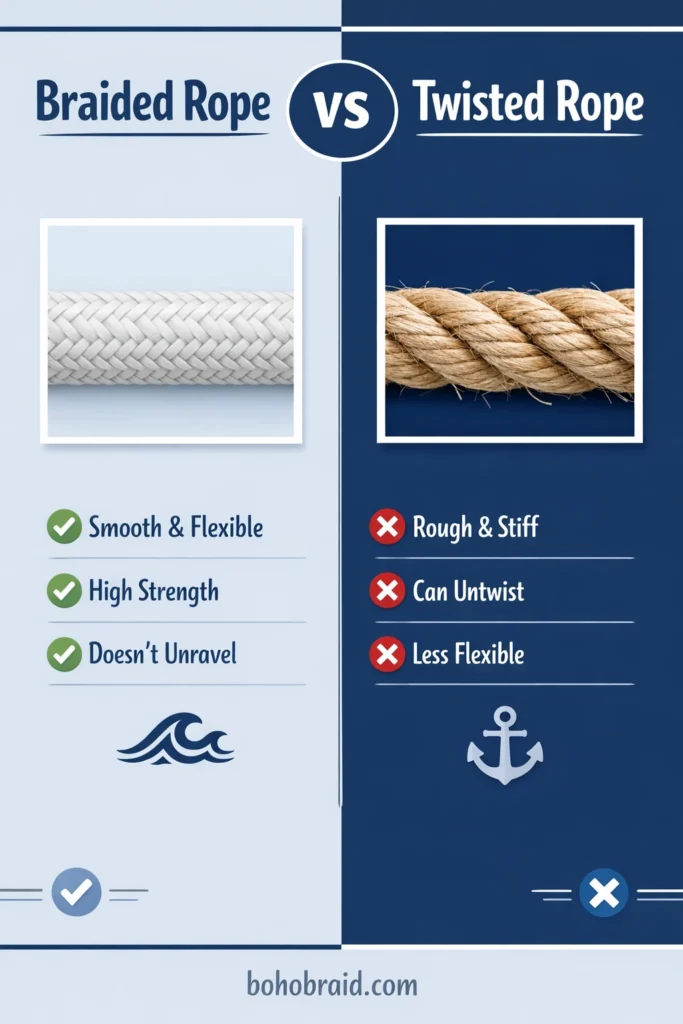
Many people confuse braided rope with twisted rope, but the difference matters depending on your project.
Braided Rope
✅ Smooth texture
✅ Flexible and easy to handle
✅ Less likely to unravel
✅ Better for pulleys and winches
✅ Often stronger and longer-lasting
Twisted Rope
✅ Usually cheaper
✅ Easier to splice in some cases
❌ More likely to kink and twist
❌ Can unravel over time
❌ Rougher surface
If you want a reliable rope that feels smooth, holds knots well, and stays stable, braided rope is usually the better choice.
Main Types of Braided Rope (By Construction)
Braided rope comes in different constructions, and that affects performance.
1) Solid Braided Rope
This rope is braided throughout without a hollow center. It’s firm, strong, and holds its shape well.
Best for:
- Outdoor work
- General-purpose tying
- Crafts and home use
2) Hollow Braided Rope
This rope has a braided outer shell with an empty center. It’s lightweight and easy to splice.
Best for:
- Marine ropes (often polypropylene)
- Pulling lines
- Temporary use and lighter tasks
3) Double-Braided Rope
Made with an inner braided core and an outer braided cover. It combines strength, durability, and smooth performance.
Best for:
- Sailing and boating
- Heavy-duty rigging
- Winches and pulleys
Best Materials for Braided Rope (And When to Use Each)
Choosing braided rope depends heavily on the **material**. Here are the most common options:
Nylon Braided Rope
Nylon is extremely popular because it’s strong and slightly elastic, which helps absorb shock.
✅ High strength
✅ Handles dynamic loads well
✅ Great abrasion resistance
❌ Absorbs water and may stretch when wet
Best for: towing, heavy loads, outdoor tasks, and general utility.
Polyester Braided Rope
Polyester is strong like nylon but has less stretch and better resistance to UV rays.
✅ Excellent UV resistance
✅ Low stretch
✅ Great for wet conditions
✅ Maintains shape and strength
❌ Slightly less shock absorption than nylon
Best for: boating, outdoor rigging, and long-term exposure to sun.
Polypropylene Braided Rope
This is lightweight and floats, which is why it’s common for water sports and marine use.
✅ Floats on water
✅ Lightweight
✅ Affordable
❌ Less durable than nylon/polyester
❌ Lower heat resistance
Best for: pool ropes, floating lines, casual marine use, light utility.
Dyneema / UHMWPE Braided Rope
This is premium rope material known for extreme strength and very low weight.
✅ Ultra-high strength-to-weight ratio
✅ Very low stretch
✅ Great chemical resistance
✅ Performs in demanding environments
❌ More expensive
❌ Can be slippery for knots
Best for: serious marine use, climbing systems (when rated), heavy-duty hauling.
Cotton or Natural Fiber Braided Rope
This is mostly used for decor and crafts, not heavy-duty work.
✅ Soft and easy to handle
✅ Great for home decor
✅ Eco-friendly
❌ Weak in wet conditions
❌ Can rot or degrade outdoors
Best for: macramé, DIY decorations, indoor crafts.
What Is Braided Rope Used For?
The versatility of braided rope is what makes it a top choice for many people.
Braided Rope for Boating and Marine Use
Braided rope works beautifully on boats because it’s smooth, strong, and runs well through pulleys.
Common uses include:
- Dock lines
- Anchor lines
- Sailing rigging
- Water rescue lines
Tip: Polyester and double-braided ropes are excellent for boating due to UV and water resistance.
Braided Rope for Camping and Survival
Braided rope is essential for outdoor adventures.
Perfect for:
- Setting up tents and tarps
- Hanging food bags safely
- Building shelter structures
- Emergency repairs and gear support
Tip: Lightweight braided polypropylene is fine for simple tasks, but nylon is better for serious use.
Braided Rope for Climbing (Safety Note)
Not all braided rope is designed for climbing. Only ropes with official climbing safety ratings should be used for human life support.
Braided rope can still be used for:
- Hauling gear
- Setting up non-life-support lines
- Outdoor utility tasks
Always check certifications if climbing is involved.
Braided Rope for Crafts, DIY, and Home Decor
Soft braided rope is trendy for home use.
Popular uses include:
- Macramé wall art
- Rope baskets
- Decorative handles
- Hanging planters
- Rustic wedding decorations
Cotton braided rope is the favorite choice here because it looks great and feels comfortable to work with.
Braided Rope for Gym Training and Fitness
You’ve probably seen braided rope battle ropes in gyms.
They’re used for:
- Strength training
- Cardio workouts
- Full-body conditioning
- HIIT sessions
Fitness ropes are often thick, durable, and designed to handle constant friction.
How Strong Is Braided Rope?
The strength of braided rope depends on three main factors:
1. Material type (Dyneema > nylon/polyester > polypropylene > cotton)
2. Diameter thickness (thicker rope = stronger rope)
3. Construction style (double-braided is usually strongest)
Even high-quality braided rope can lose strength if:
- It’s exposed to extreme heat
- It’s constantly rubbed on sharp edges
- It’s used beyond its load rating
- Knots reduce the rope’s breaking strength
Important Tip: Don’t Rely on Breaking Strength Alone
Manufacturers often list “breaking strength,” but what matters more for safety is the **working load limit (WLL)**, which is much lower and more realistic for daily use.
How to Choose the Best Braided Rope for Your Needs
To pick the right braided rope, ask yourself these questions:
1) Will It Be Used in Water?
- Choose polypropylene if you need floating rope
- Choose polyester for durability in marine conditions
- Nylon works but may stretch when wet
2) Will It Be Exposed to Sunlight?
Choose polyester because it has excellent UV resistance.
3) Do You Need Shock Absorption?
Choose nylon, especially for towing or sudden loads.
4) Do You Need Maximum Strength With Low Weight?
Choose Dyneema/UHMWPE braided rope.
5) Is It Only for Decoration or Crafts?
Choose cotton braided rope for beauty and comfort.
How to Tie Knots in Braided Rope (Quick Tips)
Braided rope handles knots well because it’s flexible and smooth. These are popular knots for braided rope:
- Bowline knot (strong loop knot)
- Clove hitch (fast securing)
- Figure-eight knot (stops rope slipping)
- Double fisherman’s knot (joining ropes)
Pro tip: Some very slippery braided ropes (like Dyneema) may need special knots or extra wraps for better grip.
How to Maintain Braided Rope and Make It Last Longer
Braided rope can last years if you care for it properly.
Here’s how:
✅ Store in a dry place away from UV rays
✅ Wash off salt water and sand after marine use
✅ Avoid dragging on sharp surfaces
✅ Check for fraying, cuts, or melted fibers
✅ Don’t overload the rope beyond its limit
If the rope looks damaged or feels stiff and weak, it’s safer to replace it than risk failure.
Conclusion
If you want a rope that’s strong, reliable, easy to handle, and built for real-world performance, braided rope is an excellent choice. Whether you’re working outdoors, boating, camping, training at the gym, or creating DIY crafts, the right braided rope can make your job easier and safer.
The key is choosing the right material and construction for your specific needs. Nylon is great for shock loads, polyester is best for UV and marine conditions, polypropylene floats and saves money, and Dyneema delivers extreme strength for demanding situations.
When in doubt, go for quality—because braided rope is one of those tools where the right choice makes a big difference.
