
If you’re searching for braids vs cornrows, you’re probably trying to choose a style that looks great and keeps your hair healthy. While both are classic, versatile, and often labeled “protective styles,” they’re not the same in technique, maintenance, scalp tension, or how long they typically last.
This guide breaks down braids vs cornrows in a clear, practical way—so you can pick the right style for your hair type, lifestyle, and comfort level (without risking breakage or traction alopecia).
Quick Definitions (So You Know Exactly What You’re Comparing)
What are braids?
“Braids” is the umbrella term for hair strands woven together into a plait. Braids can hang freely (like box braids, knotless braids, twists, rope braids, French/Dutch braids) or be partially anchored to the scalp.
What are cornrows?
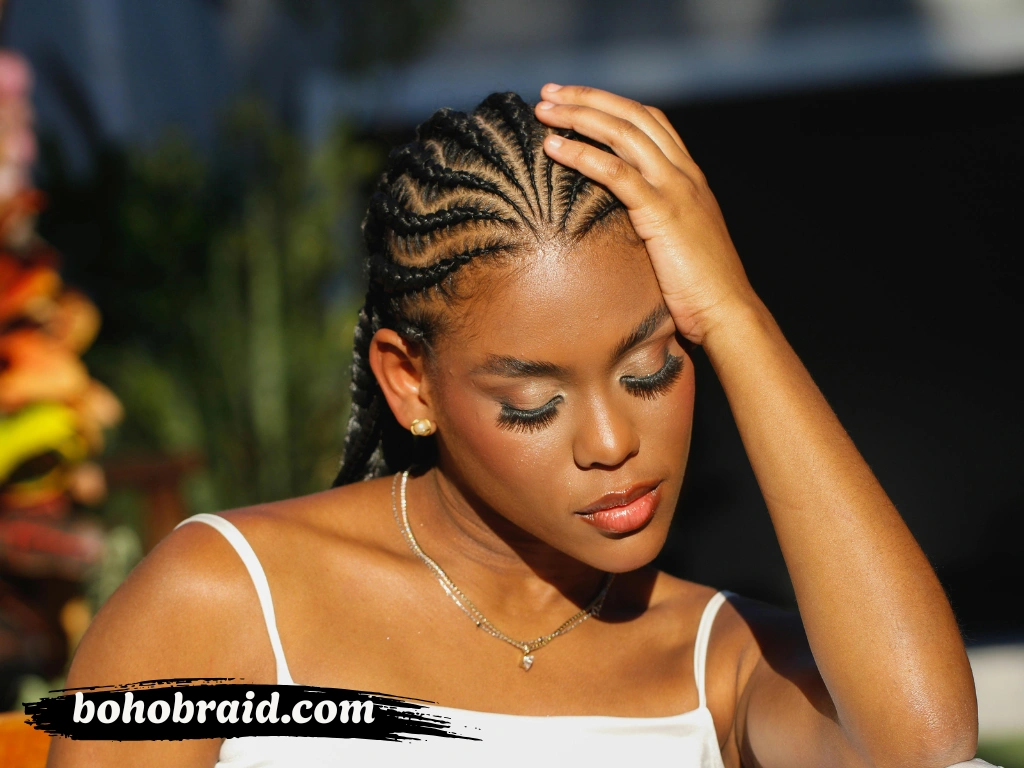
Cornrows are a specific braiding method where hair is braided close to the scalp in raised rows. They’re also called canerows in some regions and can be styled straight back, curved, zig-zag, or in intricate geometric patterns.
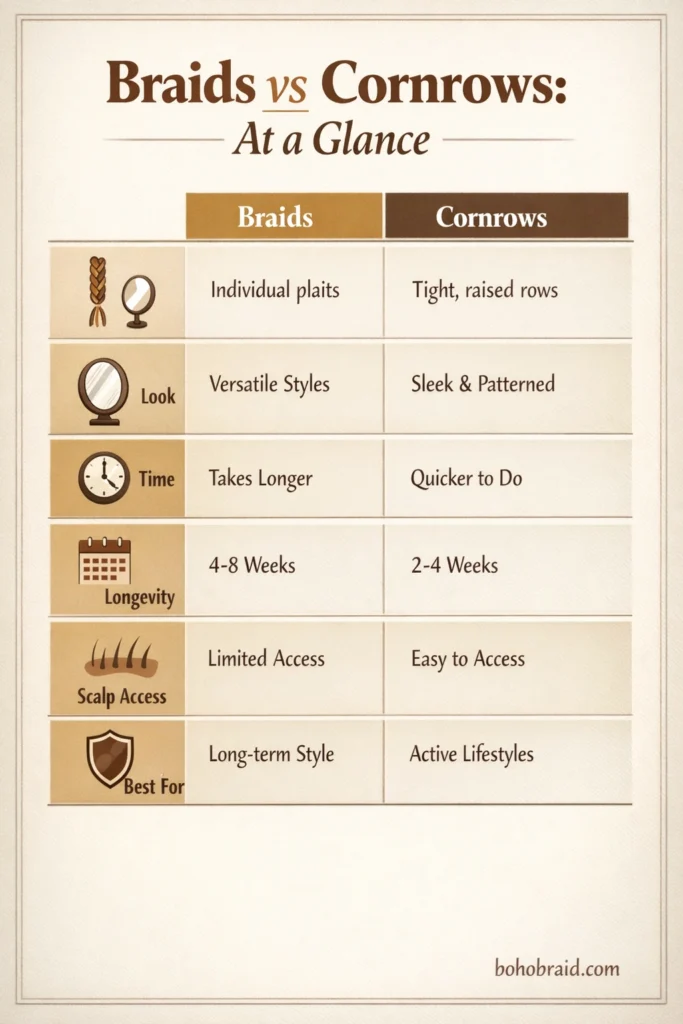
Braids vs Cornrows at a Glance
| Feature | Braids (e.g., box/knotless) | Cornrows |
|---|---|---|
| Technique | Free-hanging plaits (often sectioned) | Braided tight to scalp in rows |
| Look | Volume + movement | Sleek, patterned, scalp-visible |
| Install time | Medium–long (often 3–8 hours) | Short–medium (often 1–4 hours) |
| Typical longevity | 4–8 weeks (depends on size + care) | 1–4 weeks (depends on growth + frizz) |
| Scalp access | Moderate (parts between sections) | High (scalp exposed between rows) |
| Tension risk | Can be high with heavy extensions | Can be high if braided too tight |
| Best for | Longer wear, low daily styling | Sports, wigs, fast styling, scalp-friendly routines |
 Important: Any style that’s too tight can contribute to traction alopecia—a form of hair loss caused by repeated pulling over time. Dermatology sources specifically flag tight braids and cornrows as potential contributors when tension is high or styles are worn repeatedly without breaks.
The Real Difference: Tension, Weight, and Scalp Stress
When comparing braids vs cornrows, the biggest “hair health” factor isn’t the style—it’s tension + weight + time.
- The American Academy of Dermatology warns that hairstyles that consistently pull on the hair can lead to traction alopecia over time.
- The British Association of Dermatologists notes that tight braids (including cornrows) are common causes, with hair loss sometimes appearing between braided areas.
- Medical references emphasize prevention by avoiding high-tension styles, alternating hairstyles, and recognizing early warning signs (like soreness, redness, or thinning at the hairline).
Signs your braids or cornrows are too tight
- Scalp pain that lasts more than 24–48 hours
- Bumps, redness, or “tight” shiny scalp
- Headaches after styling
- Thinning around the hairline/temples (“edges”)
- Breakage when you take the style down
If you notice these, loosen the style quickly (or remove it). Early action matters.
Best Use Cases: When Braids Win (and When Cornrows Win)
Choose braids if you want…
1) Longer wear with less frequent re-styling
Box braids and knotless braids are often chosen for multi-week wear, especially for travel, busy schedules, or low daily manipulation.
2) More styling variety
You can wear braids down, half-up, in buns, ponytails, or accessorized looks. Just remember: tying braids into tight ponytails/buns increases tension risk.
3) Added length/volume
Braids pair easily with extensions for fuller results—though extra weight can increase pulling on the follicles.
Choose cornrows if you want…
1) A sleek, scalp-close style (great under wigs)
Cornrows are perfect as a base for wigs, sew-ins, headwraps, or quick daily routines.
2) Easier scalp access for cleansing and treatment
If you deal with dryness, dandruff, or you’re using scalp oils/serums, cornrows make it easier to reach the scalp.
3) A sport-friendly style
Cornrows stay secure during workouts and reduce daily tangling.
How Long Do They Last? (Realistic Timelines)
Longevity depends on hair texture, growth rate, braid size, and maintenance.
Braids longevity
- Small braids: 6–8 weeks (sometimes longer, but not always ideal for scalp health)
- Medium braids: 4–6 weeks
- Large braids: 2–4 weeks
The British Association of Dermatologists suggests braids shouldn’t be left in for longer than about 6 weeks, and warns that added weight/ornaments and tight updos increase traction risk.
Cornrows longevity
- Typically 1–3 weeks for a fresh look
- Up to 4 weeks if you’re gentle and don’t mind frizz/new growth
Cornrows often “age” faster visually because the scalp pattern is obvious as hair grows out.
Maintenance: What to Do Weekly (Without Overdoing It)
For braids
- Moisturize lightly (water-based spray + a small amount of oil or braid sheen)
- Clean scalp gently (diluted shampoo on the scalp, rinse carefully)
- Protect at night (satin bonnet or scarf)
- Avoid heavy buildup—too much product can cause itching and flakes
For cornrows
- Scalp care is easier: apply light oil/serum directly between rows
- Wash more comfortably: focus shampoo on scalp, smooth through rows, rinse well
- Reduce friction: satin scarf at night to prevent fuzz
Cost, Install Time, and Pain Level
- Braids often take longer and cost more because of sectioning and extension work.
- Cornrows are usually quicker and can be cheaper—unless you’re doing highly detailed designs.
Pain is not normal. Mild tenderness can happen, but significant pain is a tension warning (and tension is the real risk factor).
Which Is Healthier: Braids or Cornrows?
Neither wins by default. The healthier choice is the one that is:
- Installed with low-to-moderate tension
- Not overloaded with heavy extensions
- Worn for a reasonable duration
- Alternated with breaks (or looser styles)
Dermatology guidance repeatedly points to tension and repeated pulling as the driver of traction alopecia—not the name of the style.
Healthier styling tips (works for both)
- Ask your stylist to leave edges out (hairline hairs are delicate)
- Choose lighter hair and avoid excessive length if you’re prone to thinning
- Rotate styles (don’t repeat tight cornrows in the same direction every time)
- Take down the style if you notice soreness, bumps, or thinning
Braids vs Cornrows: How to Pick the Right One for You
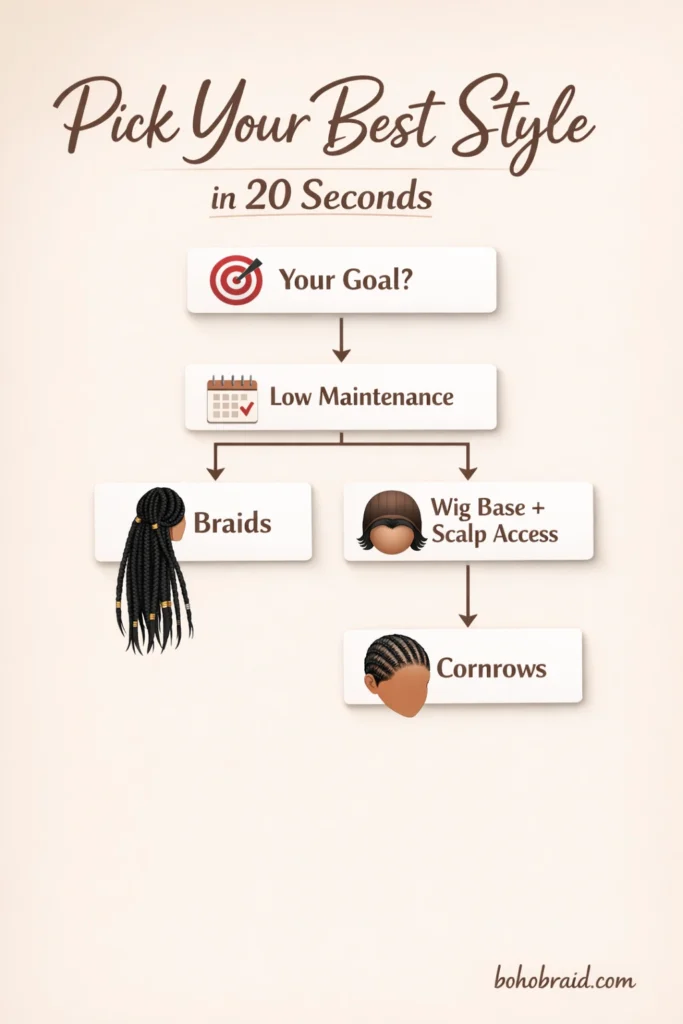
Use this quick decision checklist:
Choose braids if:
- You want 4–8 weeks of low daily styling
- You love volume/length
- You prefer lots of updo options
Choose cornrows if:
- You want sleek rows or a wig base
- You need easy scalp access
- You prefer a faster install and sport-friendly hold
If you’re unsure, a smart compromise is:
cornrows for 2–3 weeks → break → braids for 4–6 weeks → break
That rotation reduces repeated stress in the same areas.
FAQs
Are cornrows considered braids?
Yes. Cornrows are a type of braid, braided close to the scalp in raised rows.
Can braids or cornrows cause hair loss?
They can if they’re too tight, heavy, or worn repeatedly without breaks. This is linked to traction alopecia, which dermatology sources associate with high-tension styles like tight braids and cornrows.
Which lasts longer: braids or cornrows?
In most cases, braids last longer (often 4–8 weeks) while cornrows typically look freshest for 1–3 weeks.
What’s the least damaging protective style?
The least damaging “protective style” is the one with minimal tension, light weight, good scalp care, and regular breaks. Medical guidance emphasizes reducing tension and alternating styles.
Conclusion
The best answer to braids vs cornrows is simple: both can be beautiful and protective—when installed gently and maintained responsibly. If you prioritize long wear and styling versatility, go with braids. If you want sleek patterns, easy scalp care, or a wig base, cornrows are hard to beat.
